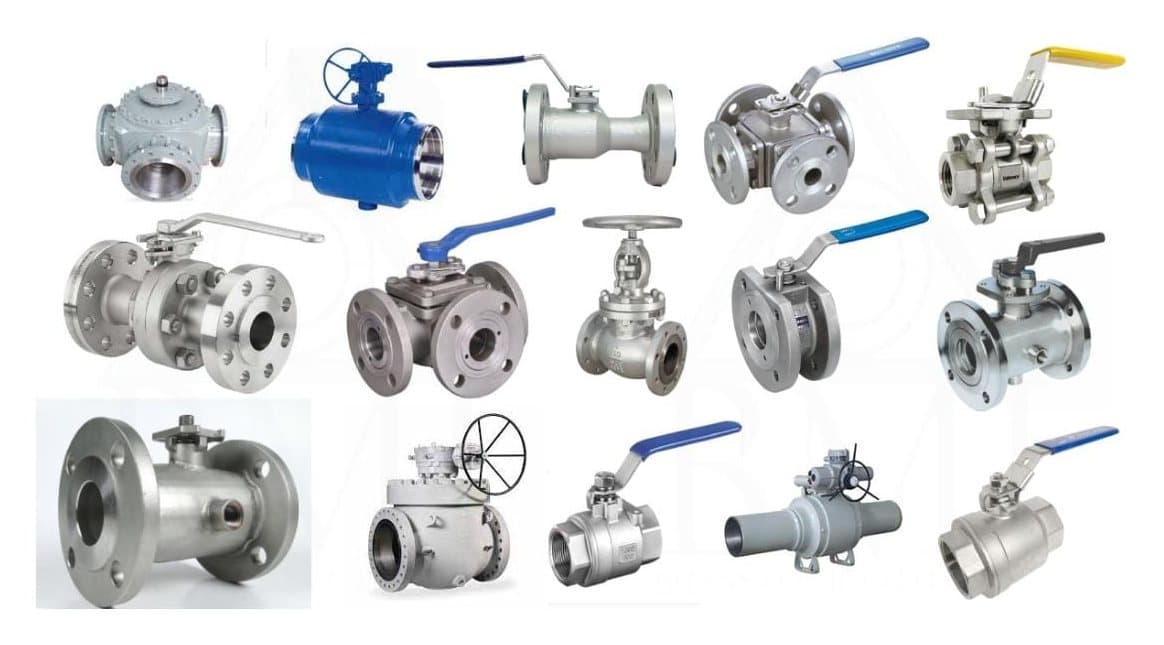
In short
Use ball and gate valves for on/off isolation, globe valves for throttling, butterfly valves for large lines where space and cost matter, and check valves to stop reverse flow. Then match the body material, seat and pressure class to the medium and temperature.
Key facts
- Ball valves give quick quarter-turn shut-off with a tight seal; PTFE seats suit most water, air and chemical service.
- Gate valves are for fully open or fully closed duty — they should not be used to throttle flow.
- Globe valves are the right choice for regulating flow.
- Butterfly valves are compact and economical on large line sizes; seat material (EPDM, NBR, PTFE) must suit the fluid.
- Check (non-return) valves protect pumps from reverse flow; swing, lift and dual-plate types suit different layouts.
A valve that is wrong for its duty either leaks, wears out early or makes the system hard to control. The selection starts with one question — what must the valve do? — and only then moves on to size, material and pressure class.
Quick selection table
| Valve type | Best for | Avoid for | Operation |
|---|---|---|---|
| Ball valve | Fast, tight on/off isolation | Long-term throttling | Quarter turn |
| Gate valve | Full-bore isolation with minimal pressure drop | Throttling, frequent operation | Multi-turn |
| Globe valve | Regulating / throttling flow | Applications needing lowest pressure drop | Multi-turn |
| Butterfly valve | Large lines, water, HVAC, low to medium pressure | Very high pressure or abrasive slurries | Quarter turn, lever or gearbox |
| Check valve | Preventing reverse flow | — (automatic, no operator) | Self-acting |
Ball valves
A stainless ball valve uses a drilled ball that turns 90° to open or close. It seals tightly, operates quickly and is easy to automate with an actuator.
- 2-piece valves are economical; 3-piece valves let you remove the centre section for maintenance without cutting the pipe.
- Full bore gives no restriction (useful for pigging and low pressure drop); reduced bore is smaller and cheaper.
- PTFE seats suit water, air, oils and most chemicals at moderate temperatures. A rating such as 1000 WOG means 1000 psi for water, oil and gas at ambient temperature — the allowable pressure falls as temperature rises.
Gate valves
A gate valve lifts a wedge clear of the flow path, so when it is fully open the pressure drop is very low. It is meant to be fully open or fully closed. Running a gate valve part-open lets the flow cut the wedge and seats, after which it no longer seals.
Rising stem (OS&Y) valves show at a glance whether they are open — useful on fire and critical lines. Non-rising stem valves need less headroom.
Globe valves
Where you need to control flow — a bypass, a steam supply to a heater, a cooling-water balance — a globe valve is the right tool. Its disc moves perpendicular to the seat, giving fine, stable regulation, at the cost of a higher pressure drop.
Butterfly valves
A butterfly valve is a disc on a shaft in a short body. It is light and compact, which makes it the economical choice on large water, cooling and HVAC lines.
- Wafer bodies clamp between two flanges; lugged bodies can hold a line under pressure with one side removed.
- Seat material decides the duty: EPDM for water and many mild chemicals, NBR for oils and fuels, PTFE for aggressive chemicals.
- Larger sizes are fitted with a gearbox or a pneumatic actuator instead of a lever.
Check valves (non-return valves)
A check valve opens with forward flow and closes when flow reverses. On a pump discharge it stops the column of water running back through the pump when it stops.
- Swing check — low pressure drop; install horizontal, or vertical with upward flow.
- Lift check — good for small sizes and higher pressure.
- Dual-plate wafer check — compact and light, fits between flanges, closes quickly to reduce water hammer.
Material and pressure class
| Body material | Typical duty |
|---|---|
| Cast steel / carbon steel | Steam, oil, high-temperature water |
| SS 304 / SS 316 | Food, chemicals, corrosive water, washdown |
| Bronze | Small bore water and marine service |
| Ductile / cast iron | Water and HVAC at moderate pressure |
End connections are threaded (BSP or NPT), socket-weld or flanged. Flanged valves must match the line's flange standard — ANSI Class 150/300 or DIN PN10/PN16.
What to send for a valve quotation
Tell us the line size, medium, temperature, pressure, end connection and how the valve will be operated (manual, gearbox or actuator). From that we can recommend the valve pattern and seat material. Browse our MS / SS valve range or send an enquiry.
Frequently asked questions
Which valve is best for throttling flow?
A globe valve is the standard choice for throttling because its disc gives fine, stable control. Butterfly valves can also regulate flow moderately. Gate valves and ball valves should be used fully open or fully closed.
What is the difference between a ball valve and a gate valve?
A ball valve shuts off with a quarter turn and seals very tightly, making it fast and easy to automate. A gate valve uses a multi-turn wedge, has very low pressure drop when fully open and is common on larger isolation duties, but it closes slowly and must not be used to throttle.
What does 1000 WOG mean on a valve?
WOG stands for water, oil and gas. A 1000 WOG valve is rated for 1000 psi (about 69 bar) of non-shock pressure at ambient temperature. The allowable pressure is lower at higher temperatures.
Where should a check valve be installed on a pump?
On the pump discharge, between the pump and the isolation valve, so that it stops reverse flow through the pump when it stops. Swing check valves must be installed horizontally or in vertical lines with upward flow.