In short
Use MS (carbon steel) pipe for water, steam, air and oil where corrosion is mild, and SS 304 or 316 for food, chemical and corrosive duty. Then pick the schedule for pressure and match the fittings and flanges to the same grade and class.
Key facts
- MS (carbon steel) pipe to ASTM A106 Gr. B or A53 suits steam, water, air and oil lines.
- SS 316 adds molybdenum for better resistance to chlorides; SS 304 suits most food and general duty.
- The schedule (SCH 20, 40, 80) sets wall thickness — a higher schedule means a thicker wall and higher pressure capacity.
- ANSI Class 150/300 and DIN PN10/PN16 flanges have different drilling and are not interchangeable.
- To get an accurate quote, send size (NB), schedule, material grade, end type and quantity.
Choosing pipe is usually a three-step decision: material, then wall thickness (schedule), then the fittings and flanges that complete the run. Getting any one of them wrong shows up later as leaks, corrosion or a flange that will not bolt up to existing plant.
Mild steel or stainless steel?
Mild steel (MS) / carbon steel pipe is the default for steam, condensate, cooling water, compressed air, fire lines and oil. It is strong, easy to weld and economical. Seamless pipe to ASTM A106 Grade B is the usual choice for steam and higher-temperature service; ASTM A53 covers general-purpose welded and seamless pipe.
Stainless steel (SS) pipe is chosen when the fluid or the environment would corrode carbon steel, or when the product must stay clean — food and beverage, pharmaceutical, chemical dosing, RO water and many textile processes. Stainless process pipe is commonly supplied to ASTM A312.
| MS (carbon steel) | SS 304 / 304L | SS 316 / 316L | |
|---|---|---|---|
| Typical standard | ASTM A106 Gr. B, A53 | ASTM A312 | ASTM A312 |
| Typical use | Steam, water, air, oil | Food, dairy, general process | Chemicals, chlorides, coastal or washdown areas |
| Corrosion resistance | Low — needs paint or coating | Good | Better, especially against chlorides |
| Relative cost | Lowest | Higher | Highest of the three |
The "L" grades (304L, 316L) have lower carbon content, which reduces the risk of corrosion along weld lines. If a line will be heavily welded on site, the L grade is usually the safer choice.
What does the schedule mean?
Pipe is ordered by nominal bore (NB) and schedule. The nominal size does not equal the real outside diameter — a 2" NB pipe, for example, has an outside diameter of about 60.3 mm regardless of schedule. The schedule changes the wall thickness, and therefore the bore and the pressure the pipe can hold.
- SCH 10 / SCH 20 — thin wall, common in stainless for low-pressure and utility lines.
- SCH 40 — the general-purpose standard for most plant piping.
- SCH 80 — thick wall for higher pressure, threaded lines (threads remove wall) and severe service.
Always match the schedule of new pipe to the fittings it will be welded to. A butt-weld elbow must have the same wall thickness as the pipe, or the bore will step at the joint.
Fittings: butt-weld, threaded and socket-weld
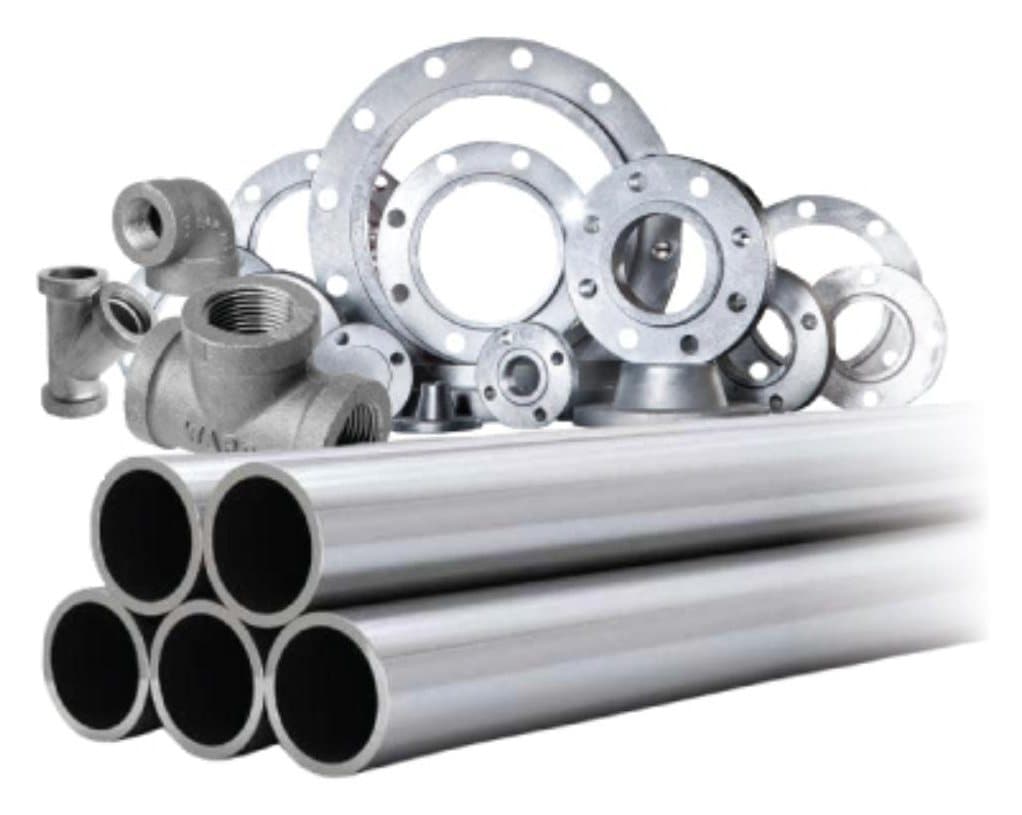
Butt-weld fittings — elbows, tees, reducers and caps — give the strongest, smoothest joint and are standard on larger and higher-pressure lines. They come in long and short radius; long-radius elbows reduce pressure drop.
Threaded and socket-weld fittings are used on small bores, typically 2" and below, where welding a butt joint is impractical. Eccentric reducers are used on pump suctions so that air cannot collect at the top of the pipe.
Flanges: match the class and the drilling
Flanges are specified by pattern, pressure class, facing and material:
- Pattern — slip-on (economical, easy to align), weld-neck (best for high pressure and cyclic loads), blind (closes a line), socket-weld (small bore).
- Class — ANSI/ASME Class 150 and 300, or DIN/EN PN10 and PN16.
- Facing — raised face (RF) or flat face (FF). Bolt a flat-faced cast-iron pump or valve flange only to a flat-face flange.
The most common mistake on maintenance jobs in Pakistan is mixing standards. Plants that grew over decades often have both ANSI and DIN equipment, and the bolt circle and hole count differ. If you are replacing a flange on existing equipment, measure the outside diameter, bolt-circle diameter, number and size of holes, or simply send us the old flange.
Practical buying checklist
Before asking for a quote, have these ready:
- Nominal size (NB) and schedule, or outside diameter and wall thickness.
- Material and grade — for example A106 Gr. B, SS 304L or SS 316.
- Seamless or welded.
- End type — plain, bevelled for welding, or threaded.
- For fittings and flanges: type, radius, class, facing and drilling standard.
- Quantity, and whether mill test certificates are required.
Where to buy pipes and fittings in Lahore
We supply MS seamless pipe, SS 304 and 316 pipe, butt-weld fittings and flanges for plants across Pakistan. If you need to match existing plant, send us the old part or a dimensioned sketch and we will match the bore, wall and drilling. Send an enquiry with your list and we will come back with a quotation.
Frequently asked questions
What is the difference between MS and SS pipe?
MS (mild or carbon steel) pipe is strong and economical but rusts without protection, so it is used for water, steam, air and oil. SS (stainless steel) pipe contains chromium, and 316 also contains molybdenum, which makes it resistant to corrosion — it is used for food, chemical and corrosive duty.
Should I choose SS 304 or SS 316 pipe?
SS 304 is suitable for most food, water and general process lines. Choose SS 316 when the fluid contains chlorides or salts, for many chemicals, or for coastal and washdown environments, because its molybdenum content gives better resistance to pitting.
What does SCH 40 mean on a pipe?
SCH 40 is the pipe schedule, which defines the wall thickness for a given nominal size. SCH 40 is the general-purpose standard; SCH 80 has a thicker wall for higher pressure, and SCH 10 or 20 a thinner wall for low-pressure lines.
Can an ANSI flange be bolted to a DIN flange?
Generally no. ANSI Class 150/300 and DIN PN10/PN16 flanges use different bolt-circle diameters and hole counts, so they do not line up. Measure the existing flange or send it as a sample so the replacement can be matched.