In short
Size a ventilation fan from the airflow you need — room volume multiplied by the air changes per hour — and the static pressure it must overcome. Axial and wall exhaust fans move large volumes at low pressure; centrifugal blowers handle ducts, filters and dust collection.
Key facts
- Required airflow (m³/h) = room volume (m³) × air changes per hour (ACH).
- Hot workshops and process areas need far more air changes than offices or stores.
- Axial fans move large volumes at low pressure; centrifugal blowers develop higher static pressure for ducted systems.
- Every exhaust fan needs an equal supply of make-up air, or it will not reach its rated flow.
- Choose galvanised or powder-coated casings and suitable motors for hot, dusty or humid plant areas.
In Pakistan's summer, a poorly ventilated workshop or warehouse quickly becomes unbearable — and hot, stale air hurts productivity, safety and product quality. Good ventilation starts with sizing the fan correctly.
Step 1: work out the airflow
The simplest method is air changes per hour (ACH):
Airflow (m³/h) = length × width × height (m) × ACH
For example, a workshop 30 m long, 15 m wide and 6 m high has a volume of 2,700 m³. At 20 air changes per hour it needs about 54,000 m³/h of exhaust.
Typical starting points (adjust for heat load, occupancy and processes):
| Area | Typical air changes per hour |
|---|---|
| Warehouses and stores | 4 – 10 |
| General workshops | 10 – 20 |
| Hot process areas, foundries, boiler and generator rooms | 20 – 60 |
| Welding bays and fume areas | Use local extraction at the source as well |
Heat from furnaces, ovens, generators and compressors increases the airflow needed. Where fumes or dust are released at one point, local extraction with a hood and duct is far more effective than trying to dilute them by ventilating the whole building.
Step 2: know the static pressure
Air moving through ducts, louvres, filters and hoods meets resistance, measured as static pressure (Pa). A fan's airflow falls as the resistance rises, so always read the flow at your system's pressure on the fan curve — not the "free air" figure.
Step 3: choose the fan type
| Fan type | Strength | Typical use |
|---|---|---|
| Wall exhaust fan | Large volume, simple installation | Workshop and warehouse general extraction |
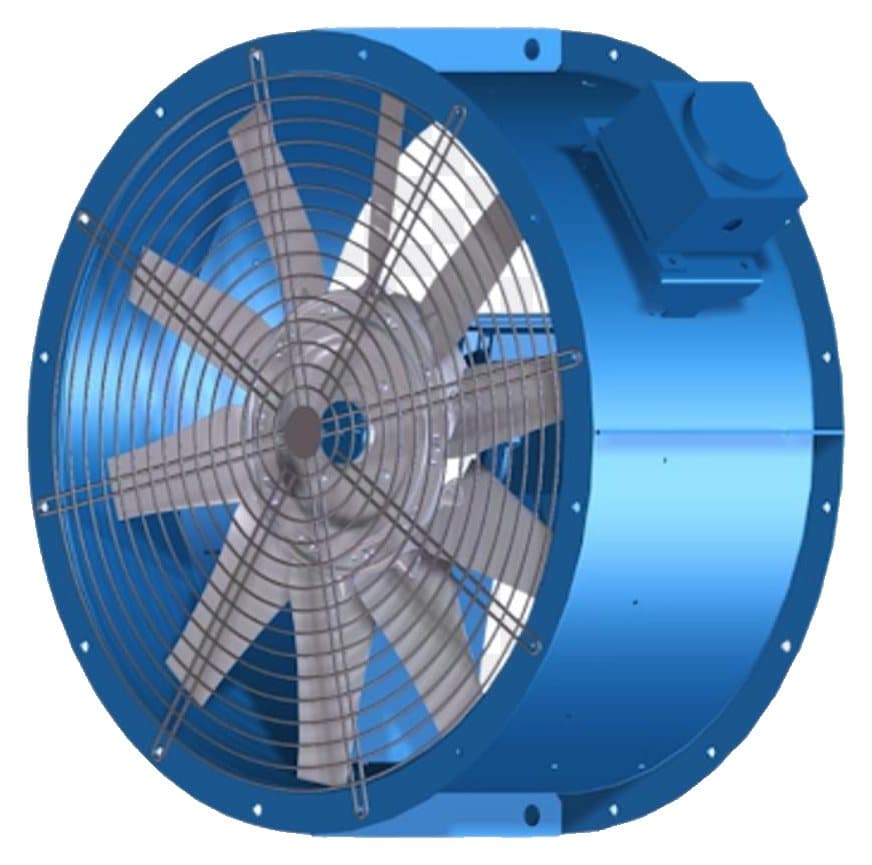
| Cased axial fan | High volume at low to medium pressure, mounts in a duct | Ventilation, cooling, in-duct boosting |
| Centrifugal blower | Higher static pressure | Dust collection, fume extraction, filters, combustion air |
Wall exhaust fans
A wall exhaust fan mounts on a wall plate with a gravity shutter that closes when the fan stops, keeping out rain and dust. Several fans spread along one wall, with inlets on the opposite wall, give an even sweep of air across the space.
Cased axial fans
A cased axial fan sits in a tube casing and can be mounted in ductwork. It moves large volumes at low to moderate pressure and comes direct-driven (simple, low maintenance) or belt-driven (speed adjustable by changing pulleys).
Centrifugal blowers
A centrifugal blower develops much higher pressure, which is needed to pull air through long ducts, filters and dust collectors.
- Backward-curved impellers are efficient and non-overloading — good for clean air and general extraction.
- Forward-curved impellers are compact and quiet for low-pressure ducted air.
- Radial impellers tolerate dust and material passing through the fan.
Don't forget make-up air
An exhaust fan can only remove as much air as can get back into the building. Without enough make-up air — open louvres, inlet fans or doors — the fan works against a negative pressure and moves far less than its rating, while doors slam and dust is drawn in through every gap.
Built for local conditions
Choose galvanised or powder-coated casings where it is humid or corrosive, motors rated for the high ambient temperatures of a Pakistani summer, and guards on every accessible fan. Fans from 12" to 48" diameter cover most plant ventilation duties.
Get a fan sized for your building
Tell us the dimensions of the space, what you are extracting (heat, fumes, dust) and how the fan will be mounted, and we will size the fan and motor. See axial and exhaust fans or send an enquiry.
Frequently asked questions
How do I calculate the size of an exhaust fan?
Multiply the room volume (length × width × height in metres) by the number of air changes per hour you need. For example, a 2,700 m³ workshop at 20 air changes per hour needs about 54,000 m³/h. Then select a fan that delivers that flow at your system's static pressure.
How many air changes per hour does a factory need?
As a starting point, warehouses need about 4–10 air changes per hour, general workshops 10–20, and hot process areas such as boiler or generator rooms 20–60. Heat load, occupancy and fumes can increase the requirement.
What is the difference between an axial fan and a centrifugal blower?
An axial fan moves air parallel to its shaft and delivers high volume at low pressure, ideal for general ventilation. A centrifugal blower throws air outward and develops much higher static pressure, which is needed for ducts, filters, dust collectors and fume extraction.
Why is my exhaust fan not pulling enough air?
The most common cause is a lack of make-up air: if air cannot enter the building, the fan works against negative pressure and its flow drops. Other causes are too much duct resistance, dirty guards or louvres, a slipping belt, or a fan that is running in reverse.