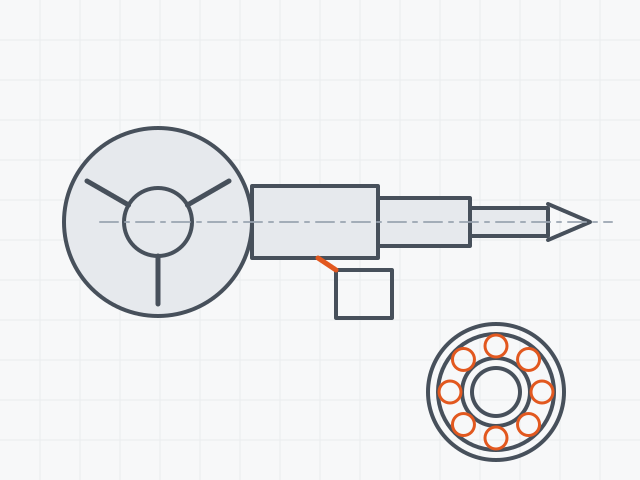
In short
A worn pump shaft, impeller or bearing housing can often be repaired — journals built up and re-machined, impellers trimmed and balanced, housings bored and sleeved — at less cost and in less time than a new part. Replacement is the better choice when a part is cracked, badly bent or corroded through.
Key facts
- Worn shaft journals can be built up and re-machined back to the original size.
- New shafts are turned from bar such as EN8, EN19, EN24, SS 410 or SS 316, to match the duty.
- Impellers are dynamically balanced after repair to protect bearings and seals.
- Bearing housings worn oversize can be bored out and sleeved back to the bearing manufacturer's fit.
- Replace rather than repair when a part is cracked, heavily corroded or bent beyond correction.
When a pump or blower fails, the quick answer is often "order a new one". On older or imported equipment, that can mean weeks of waiting and a large bill. Many worn rotating parts can be repaired to as-new dimensions in a machine shop, faster and for less.
Signs of wear to look for
- Shaft — scoring or wear under the seal or gland packing, worn bearing journals, a damaged keyway, or runout (a bent shaft) causing vibration.
- Impeller — eroded or cavitated vanes, worn wear rings increasing internal leakage, or imbalance causing vibration.
- Bearing housing — bearings spinning in the housing, a bore worn oversize or oval, and repeated bearing failures.
Rising vibration, leaking seals and falling pump performance are often the first symptoms.
Shaft repair or a new shaft?
Pump and blower shaft machining covers both routes.
Repair suits shafts that are straight and sound but worn in specific areas. Worn journals are built up and then re-machined and ground back to the original size and finish. Keyways can be re-cut and threads restored.
A new shaft is turned from bar when the old one is bent, cracked or worn beyond repair. Material is chosen for the duty:
| Material | Typical use |
|---|---|
| EN8 (medium carbon steel) | General-duty shafts, lightly loaded |
| EN19 (chrome-molybdenum steel) | Higher strength, pump and blower shafts |
| EN24 (nickel-chrome-molybdenum steel) | Heavily loaded and shock-loaded shafts |
| SS 410 | Corrosion resistance with good hardness |
| SS 316 | Corrosive liquids, food and chemical pumps |
A worn shaft or a dimensioned drawing is all that is needed to make a replacement.
Impeller repair and balancing
Impeller repair restores closed, semi-open and open impellers:
- Trimming reduces the impeller diameter to bring an oversized pump back onto its duty point and cut power consumption.
- Vane repair rebuilds eroded or cavitated vanes.
- Wear ring replacement restores the small running clearance that stops liquid recirculating inside the pump — worn rings are a common, cheap-to-fix cause of lost pump performance.
- Dynamic balancing after any repair. An unbalanced impeller shakes the shaft, shortens bearing life and damages mechanical seals. Pump impellers are commonly balanced to ISO 1940 grade G6.3.
Bearing housings and sleeves
If bearings keep failing or spinning in their seats, the housing bore is often worn. Bearing housings can be bored oversize and sleeved back to the bearing manufacturer's fit, then faced and lined up. Shaft sleeves in stainless steel, bronze or hardened steel protect the shaft under packing and seals and are far cheaper to replace than the shaft itself.
When replacement is the better call
Repair is not always the right answer. Replace the part when:
- the shaft is cracked, or bent beyond what can be straightened safely;
- an impeller is corroded through or has lost large sections of vane;
- the cost of repair approaches the cost of a new part with a shorter lead time;
- the pump itself is badly oversized or obsolete — then a new or reconditioned pump may be the smarter investment.
We measure the part, quote the repair against the cost of replacement and tell you honestly which makes more sense.
Send us the worn part
Our own workshop in Lahore handles turning, keyway cutting, threading, grinding, boring and balancing. Send the worn part or a drawing — see machine work or request a quote.
Frequently asked questions
Can a worn pump shaft be repaired?
Yes, if the shaft is straight and free of cracks. Worn journals and seal areas can be built up and then re-machined and ground back to the original size, and keyways and threads can be restored. A bent or cracked shaft should be replaced with a new one turned from suitable bar.
Why does an impeller need balancing after repair?
Any repair or trimming changes the impeller's mass distribution. An unbalanced impeller causes vibration that shortens bearing life and damages mechanical seals, so it should be dynamically balanced — pump impellers are commonly balanced to ISO 1940 grade G6.3.
Which steel is best for a pump shaft?
EN8 suits light-duty shafts, EN19 and EN24 are stronger alloy steels for heavily loaded pump and blower shafts, and stainless grades such as SS 410 or SS 316 are used where the liquid is corrosive.
What do I need to send for a shaft or impeller quote?
The worn part itself is best, because it can be measured directly. Otherwise send a dimensioned drawing, the pump make and model, and photographs of the worn areas.